
A rain gutter does not have to be limited to moving water off a roof. Mounted along a fence, wall, railing, greenhouse, shed, pergola, or freestanding frame, a gutter can become a long, narrow garden that places plants exactly where traditional beds may not fit.
Standard gutters are especially useful for strawberries, lettuces,herbs, compact flowers, and trailing plants. With appropriate supports, peas and compact beans can climb above the gutter while their roots occupy the linear planting space below.
The idea becomes even more interesting when the gutter itself is redesigned. A custom gutter that is deeper and wider than a conventional roof gutter can function less like a temporary planter and more like a long, narrow raised bed—one that can remain planted and biologically active from year to year.
Turn fences, walls, deck rails, greenhouse sides, and otherwise unused edges into productive growing areas.
A gutter naturally creates a continuous planting line that works well for strawberries, greens, herbs, flowers, peas, and beans.
Mounted gutters can reduce bending and put harvesting, pruning, and inspection at a convenient height.
Strawberry runners, nasturtiums, petunias, alyssum, and other trailing plants can spill naturally over the front edge.
Peas and compact climbing beans can use the gutter as the root zone while netting or wire above creates the vertical growing area.
Where appropriate, rainfall can be directed through or toward the garden, reducing dependence on hand watering.
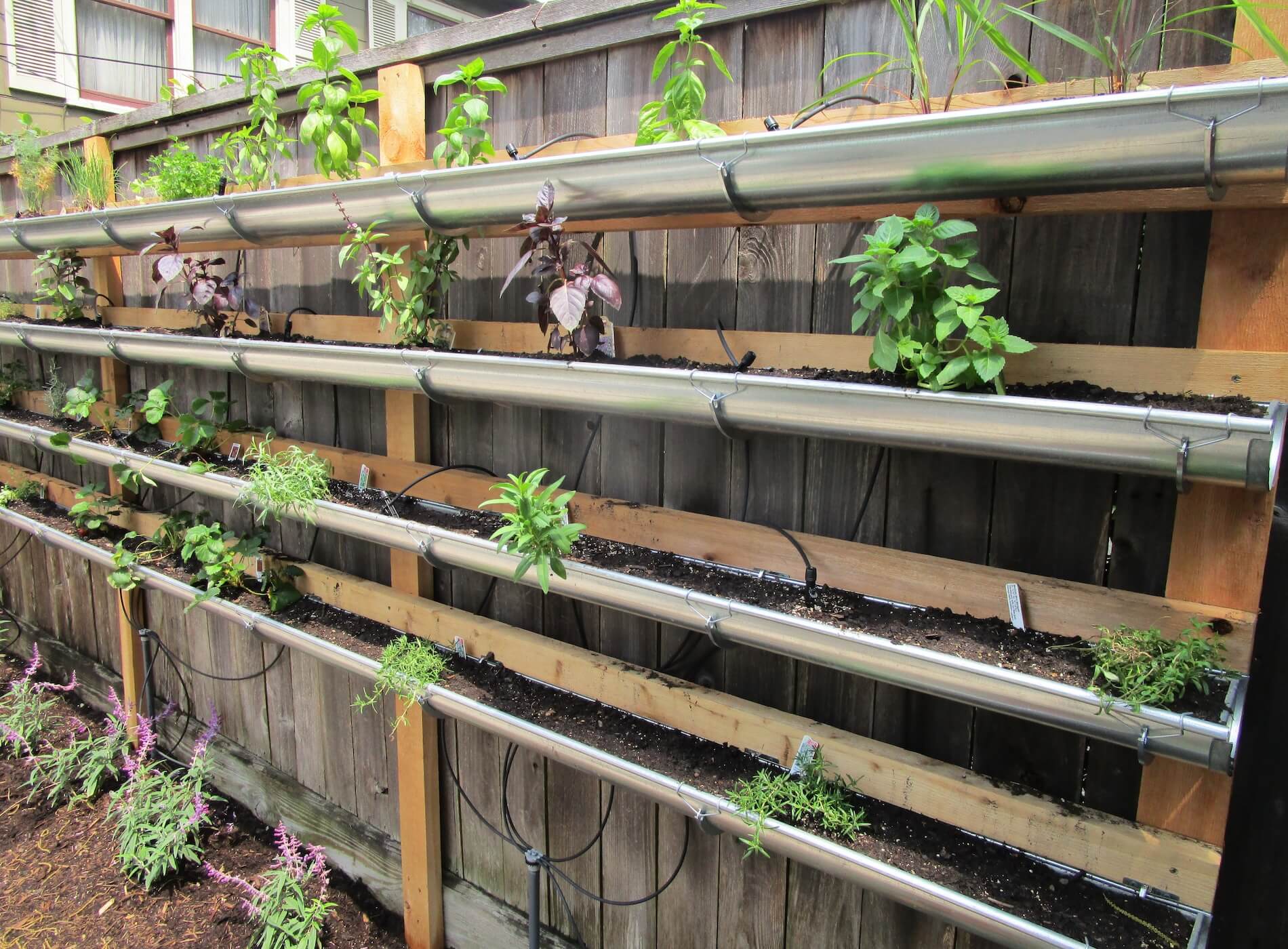
The depth of the gutter determines what kind of garden it can become. Conventional residential gutters hold relatively little growing medium. They are excellent for shallow-rooted crops and seasonal planting, but the limited soil volume means they dry quickly and offer less buffering against heat, missed watering, and nutrient depletion.
A purpose-built deeper gutter changes the system. Increasing both depth and width provides more root volume, more water-holding capacity, more stable soil temperatures, and more room for organic matter and soil organisms.
| Gutter Type | Best Uses | Management |
|---|---|---|
| Standard shallow gutter | Strawberries, lettuce, herbs, annual flowers, trailing plants, seedlings | Frequent moisture checks; seasonal top-up or partial soil refresh |
| Moderately deep custom gutter | Strawberries, greens, herbs, peas, compact beans, flowers | Top-dress with compost and mulch; maintain drainage |
| Deep linear gutter bed | Long-term mixed planting, larger-rooted crops, perennial strawberries, living-soil systems | Treat like a narrow raised bed rather than an annual pot |
Strawberries fit the geometry of a gutter exceptionally well. Plants can be spaced in a straight row, crowns remain easy to inspect, flowers and fruit hang over the edge, and runners can either trail decoratively or be rooted into nearby spaces.
Peas and suitable compact or climbing beans add a second dimension to gutter gardening. The gutter provides the root zone while trellis netting, wire, string, or a framed support rises above it.
Peas are particularly attractive for cool-season gutter gardens. Beans need greater root volume and reliable moisture, so deeper custom gutters are better suited to them than the shallowest residential profiles. Bush and compact varieties reduce the structural load created by large vines.
Gutter gardens can be ornamental as well as productive. Mounted high enough, plants can cascade downward to soften a fence or wall. Multiple levels can create bands of color without taking up valuable patio or garden-floor space.
Edible flowers and leaves with a natural trailing habit.
Long flowering displays that spill over the gutter edge.
Compact flowers that can soften the front edge and attract small pollinators.
Thyme and other compact herbs can grow over the edge while remaining easy to harvest.
One of the limitations of conventional container gardening is the tendency to treat potting mix as disposable. A deep gutter garden can be managed differently. If the structure is durable and the soil volume is large enough, the growing medium can stay in place from year to year.
Old roots decompose, compost adds new organic matter, mulch protects the surface, earthworms and other soil organisms may colonize suitable systems, and microbial communities develop around living roots. Over time the gutter becomes less like a flower box and more like a narrow strip of biologically active garden soil.
A gutter garden located below a sloped roof creates an obvious opportunity to make use of rainfall. Roof runoff may carry small amounts of dust, pollen, leaf particles, and other organic material, but that does not make it a dependable fertilizer. The main benefit is water capture.
The nutrient supply for a productive gutter garden should still come from healthy soil, compost, decomposing organic matter, and appropriate amendments. Roof water should be considered irrigation first—not a replacement for soil fertility.
A full roof can collect far more water during a storm than a narrow planted gutter can absorb. Directing an entire roof downspout into a small planting channel can wash out soil, expose roots, and waterlog plants.
Gutters are designed to hold and move water, so a planted gutter needs intentional drainage. Roots require both water and oxygen. A gutter that remains full after irrigation can quickly become a saturated trough.
Drainage openings should be numerous enough to prevent standing water while still retaining the growing medium. A slight planned slope can help move excess water toward an outlet, although the soil surface itself should remain stable enough that irrigation does not carry soil toward one end.
Soil becomes heavy when wet. A long deep gutter filled with moist soil, plants, mulch, and irrigation water can place a substantial load on brackets, railings, fences, walls, and freestanding frames.
One long gutter—or several staggered rows—filled with strawberries whose fruit and runners hang over the front.
Mount a deep gutter below mesh or string so peas climb vertically while roots remain in an accessible row.
Use a deeper reinforced gutter and trellis to create an edible seasonal privacy screen with suitable bean varieties.
Combine petunias, alyssum, nasturtiums, and other trailing flowers for a long ribbon of color.
Place parsley, chives, thyme, basil, and other frequently harvested herbs close to the kitchen.
Grow rows of leaf lettuce, arugula, baby greens, and herbs for repeated cut-and-come-again harvests.
Create a long flowering corridor with compact species suited to the local climate and gutter depth.
Build an extra-deep custom channel, keep the soil year-round, top-dress it, mulch it, and manage it as a narrow raised bed.
Dark metal gutters can heat rapidly in strong sun. Light-colored finishes, exterior shading, mulch, or insulating liners can moderate root-zone temperatures. Plastic gutters avoid rust but may need UV-resistant construction and closer structural support. Metal systems should use materials and coatings appropriate for the intended crops.
If the garden is intended to remain in place for years, build it as permanent infrastructure from the beginning. Make drains serviceable, leave access for soil top-dressing, and design trellises so they can be repaired without dismantling the whole growing bed.
Strawberries, lettuce, herbs, compact flowers, trailing ornamentals, peas, and suitable compact beans can all work when the gutter provides enough soil volume, drainage, light, irrigation, and support.
They are best for shallow-rooted crops and seasonal plantings. A deeper custom gutter provides a much better root environment for peas, beans, long-term strawberries, and crops that need more moisture buffering.
Their root systems fit relatively compact spaces, their fruit and runners can hang over the edge, and many plants can be arranged along a narrow linear bed without using much ground area.
Yes. If the structure has adequate depth, drainage, durability, and soil volume, maintain the soil like a raised bed: top-dress with compost, mulch the surface, add organic matter, and correct fertility or pH when needed instead of replacing everything annually.
Not reliably. Roof runoff may contain small amounts of organic debris, but it should primarily be considered a water source. Soil fertility should come from compost, organic matter, healthy soil biology, and appropriate amendments.
That depends on the roof, gutters, collection materials, local air quality, and the way the water is handled. Unknown roof runoff can carry contaminants, so edible systems should use materials and rainwater practices considered suitable for food-growing applications.
Explore other ways to grow productive plants in containers, raised systems, and repurposed garden structures.