
The best children's garden is not necessarily the biggest or most elaborate. It is the garden that keeps giving a child something to notice: a seed pushing through the soil, a flower opening, a bean getting longer, a strawberry turning red, or a radish suddenly ready to pull.
Kid-friendly plants should be reasonably forgiving, interesting to touch or smell, easy to recognize, and rewarding enough that children want to come back tomorrow. A mix of quick crops and longer-season plants works especially well because there is almost always something changing.
Radishes are one of the best quick-win crops. Children can watch the leaves appear and then pull a fully formed root from the soil only a few weeks later.
Leaf lettuce grows quickly, can be harvested a little at a time, and helps children understand that food can be picked fresh and continue growing.
Beans have large seeds that are easy for small hands to plant. Bush varieties stay compact and produce pods that are easy to spot and harvest.
Peas make gardening interactive. Children can guide vines onto a small trellis, look for flowers, and search through the foliage for developing pods.
Carrots add suspense because most of the crop develops underground. Pulling the first carrot is often one of the most memorable moments in a child's garden.
Compact cherry tomato varieties provide flowers, developing fruit, and a long series of colorful harvests. Choose a variety suited to the available space.
Basil is strongly scented, easy to recognize, and responds well to regular harvesting. Children can smell, touch, and taste the result of their care.
Strawberries are especially engaging because children can follow the entire transformation from flower to tiny green berry to ripe red fruit.
Sunflowers provide dramatic growth and make height easy to measure. Dwarf varieties are useful where space is limited, while taller types create a memorable garden feature.
Marigolds offer bright flowers over a long period and are useful for teaching children about flowering plants, pollinators, and deadheading.
Nasturtiums produce distinctive round leaves and bright flowers. Their unusual appearance makes them easy for children to recognize and observe.
Chives are durable, easy to snip, and often return year after year. Their purple flowers also provide another stage for children to watch.
Young gardeners often stay interested when something changes quickly. Radishes, lettuce, bush beans, peas, and basil are useful starter choices because germination or early growth is easy to see.
Pairing fast crops with slower plants works well. A child might harvest lettuce while waiting for tomatoes to flower, or pull radishes while sunflowers are still climbing.
Children do not need a backyard to grow successfully. Containers can make a first garden easier because the planting area is clearly defined and can be placed close to a door, patio, deck, or classroom.
Match the container to the mature size of the plant, make sure it has drainage holes, and remember that containers usually dry out faster than garden soil.
Growing food creates a direct connection between gardening and the kitchen. A child who plants a bean seed and later picks the pod has experienced the entire food cycle in a way no worksheet can reproduce.
Large-seeded crops such as beans are particularly easy for children to handle. Small raised beds can also make harvesting easier and keep the garden at a comfortable height. See Growing to Give's examples of community and raised-bed gardens.
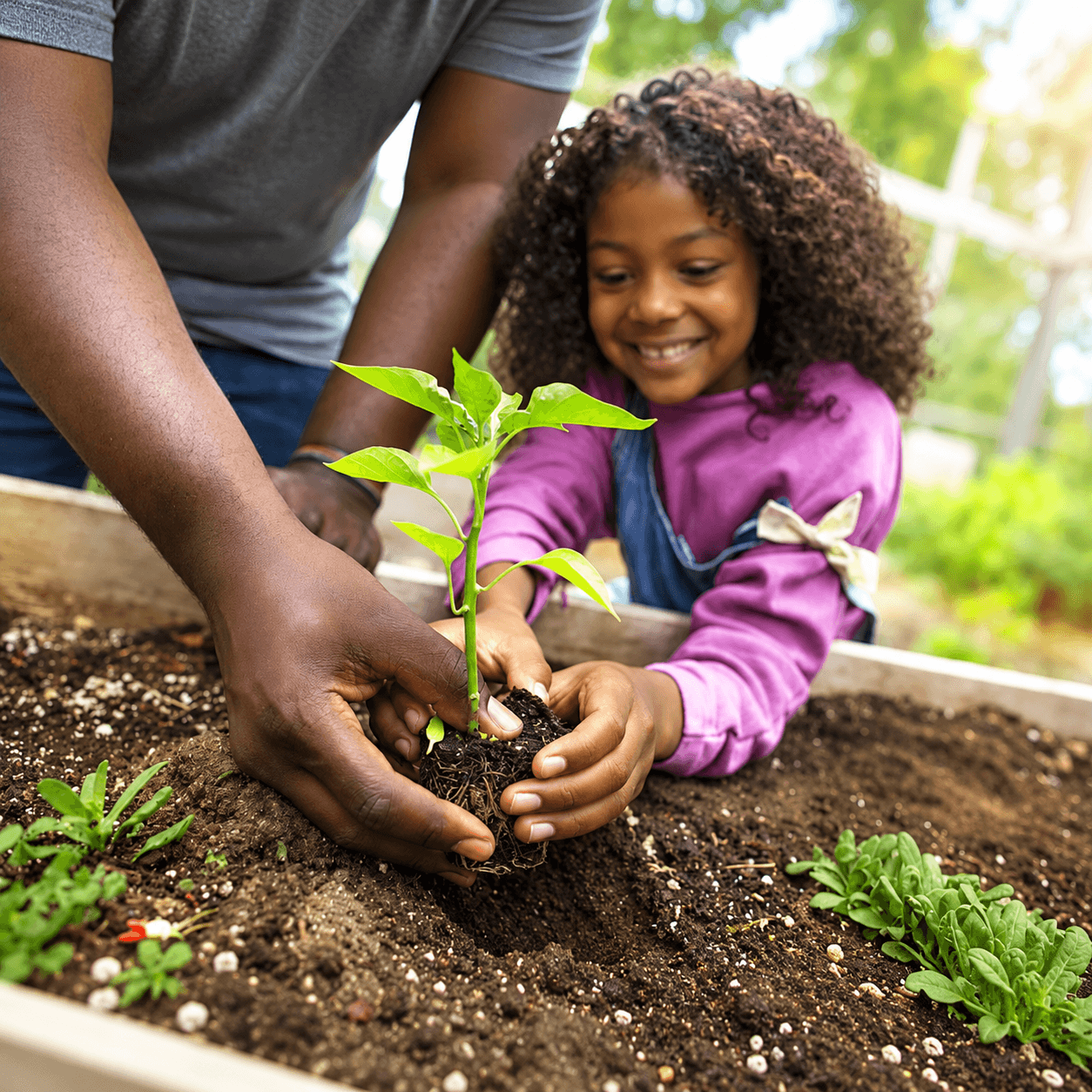
Ownership changes the experience. A child's garden does not have to be large, but it should feel like theirs. A labeled container, one section of a raised bed, or a small garden row gives children a place where they can make decisions and see the results.
A children's garden becomes much more interesting when every plant does something different. Vegetables provide a harvest, herbs introduce fragrance and taste, and flowers attract insects and add color.
A simple combination might include bush beans, leaf lettuce, basil, strawberries, and marigolds. In a larger bed, add peas on a short trellis or a sunflower at the back.
A perfect harvest is not the goal. Children learn from seeds that fail to germinate, leaves that get chewed, fruit that takes longer than expected, and plants that suddenly grow faster after a change in weather.
Those small surprises build observation skills and confidence. The garden becomes a living experiment where children can ask questions, try something, and see what happens.
That spirit is at the heart of Gardening for Everyone: making gardening approachable for children, beginners, seniors, families, and communities rather than treating it as a skill reserved for experts.
Children should garden with age-appropriate supervision. Use plants you can positively identify, keep garden chemicals and fertilizers out of reach, and teach children not to eat unknown berries, leaves, seeds, mushrooms, or flowers.
For a first attempt, keep it simple: one container of bush beans, one container of lettuce or radishes, a strawberry plant, basil, and one colorful flower. That is enough variety to provide seeds, leaves, flowers, fruit, fragrance, and several kinds of harvest.
Once children experience success, the garden can expand naturally. The next step might be a small raised bed, a pea trellis, a tomato container, or even a shared family garden.
Radishes, bush beans, lettuce, peas, basil, marigolds, nasturtiums, sunflowers, strawberries, carrots, cherry tomatoes, and chives are all good choices. The best selection depends on season, climate, sunlight, and available space.
Radishes, lettuce, bush beans, peas, and many herbs provide relatively fast visible growth. Mixing these with slower crops gives children something to watch while they wait for longer-season plants.
Yes. Containers are one of the easiest ways to introduce gardening. Choose a container large enough for the mature plant, provide drainage, use an appropriate growing medium, and place it where the plant receives the light it needs.
Grow known plants, supervise young children, keep chemicals inaccessible, use age-appropriate tools, wash harvested produce, and teach children never to taste an unidentified plant or mushroom.
Small is usually better at first. A few containers or a short raised bed provides enough responsibility and variety without turning the garden into a chore.
Explore more family-friendly gardening ideas, practical calculators, and a real-life story about how gardening helped get kids excited about vegetables.